

Mtskheta, Gori & Uplistsikhe: The Ultimate Day Trip from Tbilisi
If you only have one day to step outside Tbilisi and explore Georgia's ancient past, this is the trip to take. In a single day, you'll stand inside Georgia's holiest cathedral, explore a 3,000-year-old cave city carved into volcanic rock, and visit the birthplace of one of the 20th century's most powerful figures. This is Georgia at its most historically rich — and it's all just a short drive from Tbilisi.
Why This Day Trip Belongs on Every Georgia Itinerary
Georgia is a country where history runs deep — and nowhere is that more apparent than on the road west from Tbilisi. Within an hour of leaving the capital, you'll pass through landscapes that have been continuously settled for thousands of years, dotted with medieval fortresses, ancient monasteries, and rock-cut cities that predate written history.
The Mtskheta–Gori–Uplistsikhe day trip is one of the most popular excursions from Tbilisi for good reason. It packs an extraordinary amount of history, architecture, and scenery into a single day, covering three completely different chapters of Georgia's past — early Christianity, Soviet history, and prehistoric civilization.
Stop 1: Jvari Monastery — Where Georgia's Christian Story Begins
Every great Georgia tour starts with Jvari Monastery, and for good reason. Perched on a rocky hilltop above the ancient town of Mtskheta, this small 6th-century church is one of the oldest and most important religious buildings in the entire Caucasus.
What makes Jvari special?
Jvari — meaning "cross" in Georgian — marks the site where Saint Nino, the missionary who brought Christianity to Georgia in 337 AD, is said to have planted a wooden cross to celebrate the country's conversion. The current stone church was built between 586 and 604 AD and has stood virtually unchanged ever since.
From the monastery's hilltop position, you get one of the most photographed views in all of Georgia — the dramatic confluence of the Aragvi and Mtkvari (Kura) rivers, flowing together in the valley far below. It's a view so striking that the Russian poet Mikhail Lermontov immortalized it in his famous poem "Mtsyri" in 1839.
Jvari is a UNESCO World Heritage Site and remains an active place of worship to this day. Arrive early in the morning if possible — the light on the stone walls is extraordinary, and the hilltop is quieter before tour groups arrive.
Key facts:
Built: 586–604 AD
UNESCO World Heritage Site since 1994
Located 20 km from Tbilisi
Entry: free
Stop 2: Svetitskhoveli Cathedral — The Spiritual Heart of Georgia
From Jvari, the tour descends into Mtskheta itself — one of the oldest continuously inhabited cities in the world and the ancient capital of the Kingdom of Iberia. For centuries before Tbilisi was founded, Mtskheta was the political and spiritual center of Georgia.
At the heart of the old town stands Svetitskhoveli Cathedral — without question the most sacred church in Georgia, and one of the most important Christian monuments in the entire Caucasus.
Why is Svetitskhoveli so significant?
The name Svetitskhoveli translates as "Life-Giving Pillar" — a reference to one of the most remarkable legends in Georgian Christianity. According to tradition, a Georgian Jew named Elias brought the burial robe (chiton) of Christ back from Jerusalem after the Crucifixion. When Elias's sister Sidonia touched the robe, she died instantly from its divine power and was buried holding it. A cedar tree later grew from her grave, and when Saint Nino ordered it cut down to build a church, the pillar that was made from it rose into the air on its own and glowed with a holy light before descending into place. This pillar — the Svetitskhoveli — is believed to still stand inside the cathedral today.
Whether or not you come for the legend, the cathedral is an architectural masterpiece. The current structure dates to the 11th century (built 1010–1029 AD) and is the largest medieval building in Georgia, featuring beautifully carved stone facades, frescoes spanning centuries, and the tombs of Georgian kings and Catholicos.
Svetitskhoveli is also a UNESCO World Heritage Site and remains one of the most visited sites in Georgia by both pilgrims and tourists.
Key facts:
Originally built 4th century; current structure 1010–1029 AD
UNESCO World Heritage Site since 1994
Believed to house the burial robe of Christ
Located in central Mtskheta, 20 km from Tbilisi
Stop 3: Stalin Museum, Gori — Georgia's Most Controversial Attraction
From the spiritual serenity of Mtskheta, the tour continues west to Gori — a pleasant Georgian city with a remarkable claim to fame. On December 18, 1878, Joseph Vissarionovich Jughashvili was born here in a small worker's cottage. The world would come to know him as Joseph Stalin.
The Stalin Museum in Gori is one of the most visited and most talked-about museums in the entire Caucasus — and one of the most unusual museum experiences you'll find anywhere in the world.
What's inside the Stalin Museum?
The museum complex covers an entire city block and includes several distinct parts:
Stalin's Childhood Home — the tiny one-room cottage where Stalin was born and spent his early years, preserved beneath a grand classical canopy
The Main Museum Building — a palatial Soviet-era structure housing thousands of exhibits including personal photographs, gifts from world leaders, documents, uniforms, death masks, and detailed accounts of his rise from Georgian seminary student to leader of the Soviet Union
Stalin's Personal Railway Carriage — a lavishly fitted armored train car used by Stalin for travel, including to the 1945 Yalta Conference with Churchill and Roosevelt, preserved in immaculate condition in the museum grounds
The museum presents Stalin's life and legacy with a distinctly Soviet lens — it's as fascinating as a historical document as it is as a museum. Whether you view Stalin as a war hero, a tyrant, or one of history's most complex figures, a visit to Gori offers an irreplaceable window into 20th-century history that you simply cannot get anywhere else.
Key facts:
Located in central Gori, 80 km from Tbilisi
Covers Stalin's full life from birth to death in 1953
Includes childhood home, main museum, and armored railway carriage
One of the most visited museums in Georgia
Stop 4: Uplistsikhe — A City Older Than History
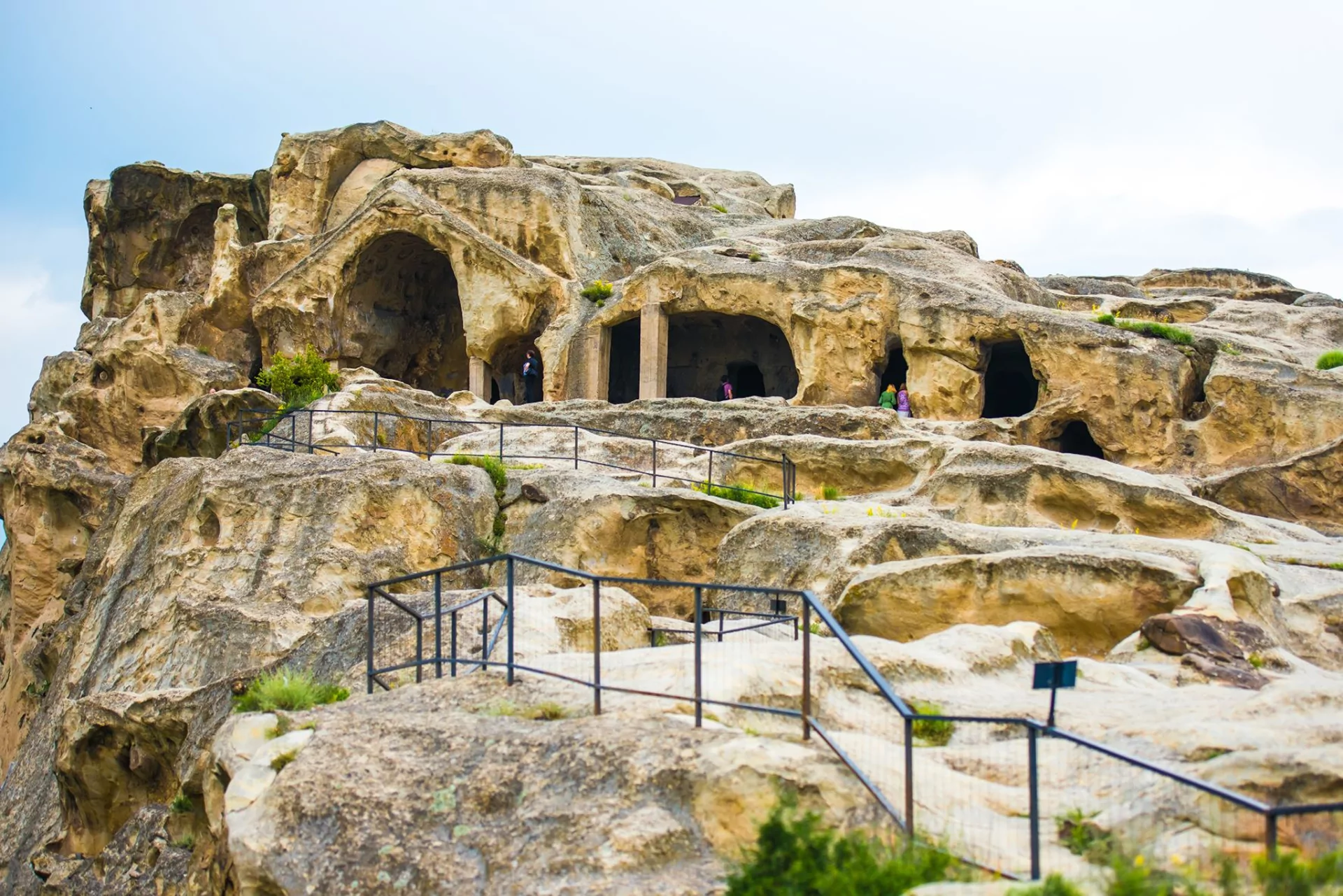
The final stop of the day is perhaps the most extraordinary of all. Just outside Gori, rising from the banks of the Mtkvari River, is Uplistsikhe — one of the oldest urban settlements ever discovered in Georgia, and one of the most remarkable archaeological sites in the South Caucasus.
What is Uplistsikhe?
Uplistsikhe ("Fortress of the Lord" in Georgian) is an ancient rock-hewn city carved directly into the volcanic sandstone cliffs above the Mtkvari River. Settlement here began as far back as the early Iron Age, around 1000 BC, making it at least 3,000 years old — though some estimates place the earliest occupation even earlier, between 3,000 and 5,000 years ago.
At its peak, Uplistsikhe was a major political, religious, and cultural center of ancient Georgia. The city grew to cover an area of roughly 8 hectares, and at its height may have been home to tens of thousands of people.
What can you see at Uplistsikhe?
Walking through Uplistsikhe today is like stepping directly into the ancient world. The site contains:
Rock-cut streets and staircases — the main street of the ancient city still runs through the complex, flanked by cave rooms on either side
Pagan temples and shrines — Uplistsikhe predates Christianity and contains some of the most important pre-Christian religious architecture in Georgia, including a large cave hall believed to have served as a pagan temple
The Uplistsulis Darbazi (the "Hall of the Lord") — the city's largest cave hall, with a distinctive carved ceiling that mimics wooden architectural techniques in stone
A 9th-century basilica — built after Georgia's Christianization, demonstrating the city's long continuous use across different eras
Underground tunnels — a network of secret passages connecting different parts of the city, some of which can still be explored
Panoramic views — from the top of the cliff, sweeping views over the Mtkvari River valley and the surrounding Georgian countryside
Uplistsikhe was eventually abandoned in the 13th century following the Mongol invasions, but what remains is extraordinarily well preserved, thanks largely to the durability of the volcanic stone from which the entire city was carved.
Key facts:
Founded approximately 1000 BC (Iron Age)
Covers 8 hectares of carved rock
Contains pagan temples, cave halls, streets, and a Christian basilica
Located 10 km from Gori, 90 km from Tbilisi
Entry: included in Georgia excursion ticket
Practical Information: Booking the Mtskheta–Gori–Uplistsikhe Day Trip
How long does the tour take? The full excursion runs from 09:00 to 19:00 — a comfortable full day with plenty of time at each stop without feeling rushed.
Where does the tour start? All Imperial Tours excursions depart from Abanotubani, Abano Street 15 in Old Tbilisi — right in the heart of the sulfur bath district, easy to find and well-connected to all major hotels.
What's included?
Professional English-speaking guide
Comfortable minibus with Wi-Fi
All transport between sites
What's not included?
Entry tickets (budget approximately 30 GEL per person)
Lunch (there are good local restaurants in both Mtskheta and Gori)
Personal expenses
Can I customize the tour? Yes — Imperial Tours offers fully flexible scheduling. The tour runs daily and can be adjusted, combined with other excursions, or booked as part of a longer multi-day Georgia package.
Tips for Visiting Mtskheta, Gori & Uplistsikhe
Dress modestly for the churches — shoulders and knees should be covered at both Jvari and Svetitskhoveli. Scarves and wraps are sometimes available at the entrance but it's best to bring your own.
Wear comfortable shoes — Uplistsikhe involves uneven rocky terrain, steep staircases, and open cliff edges. Sturdy footwear is essential.
Bring water and snacks — especially for Uplistsikhe, where there are no facilities inside the site.
Visit Jvari early — the morning light on the stone and the views over Mtskheta are best before midday, and the site is quieter before large groups arrive.
Allow time in Mtskheta — after Svetitskhoveli, the old town of Mtskheta has charming streets, souvenir shops, and excellent traditional Georgian restaurants perfect for a quick lunch.
Why Book with Imperial Tours?
Imperial Tours has been organizing excursions across Georgia since 2014, hosting thousands of guests from around the world with consistently high standards of service, guiding, and local knowledge.
✅ Daily departures — book any date that suits you
✅ Professional English-speaking guides with deep expertise in Georgian history
✅ Comfortable, air-conditioned minibus with Wi-Fi
✅ Small group sizes for a more personal experience
✅ Flexible itineraries — swap, add, or remove stops to suit your interests
✅ Group discounts available for 2–7 people
Ready to Explore Ancient Georgia?
The Mtskheta–Gori–Uplistsikhe day trip is one of the most rewarding excursions you can take from Tbilisi — a full day that will leave you with a completely new understanding of Georgia's extraordinary history, from its earliest civilizations to its defining moments of the 20th century.
? Book your tour today — contact Irina: +995 571 31 80 08 (WhatsApp / Viber / Telegram)
? Meeting point: Abanotubani, Abano Street 15, Old Tbilisi
? imperialtours.ge